
Writing Toward Wholeness: Carl Jung, the Unconscious, and the Work of Knowing Yourself
A comprehensive exploration of Jung’s ideas on the persona, shadow, dreams, and active imagination, grounded in his books and words.
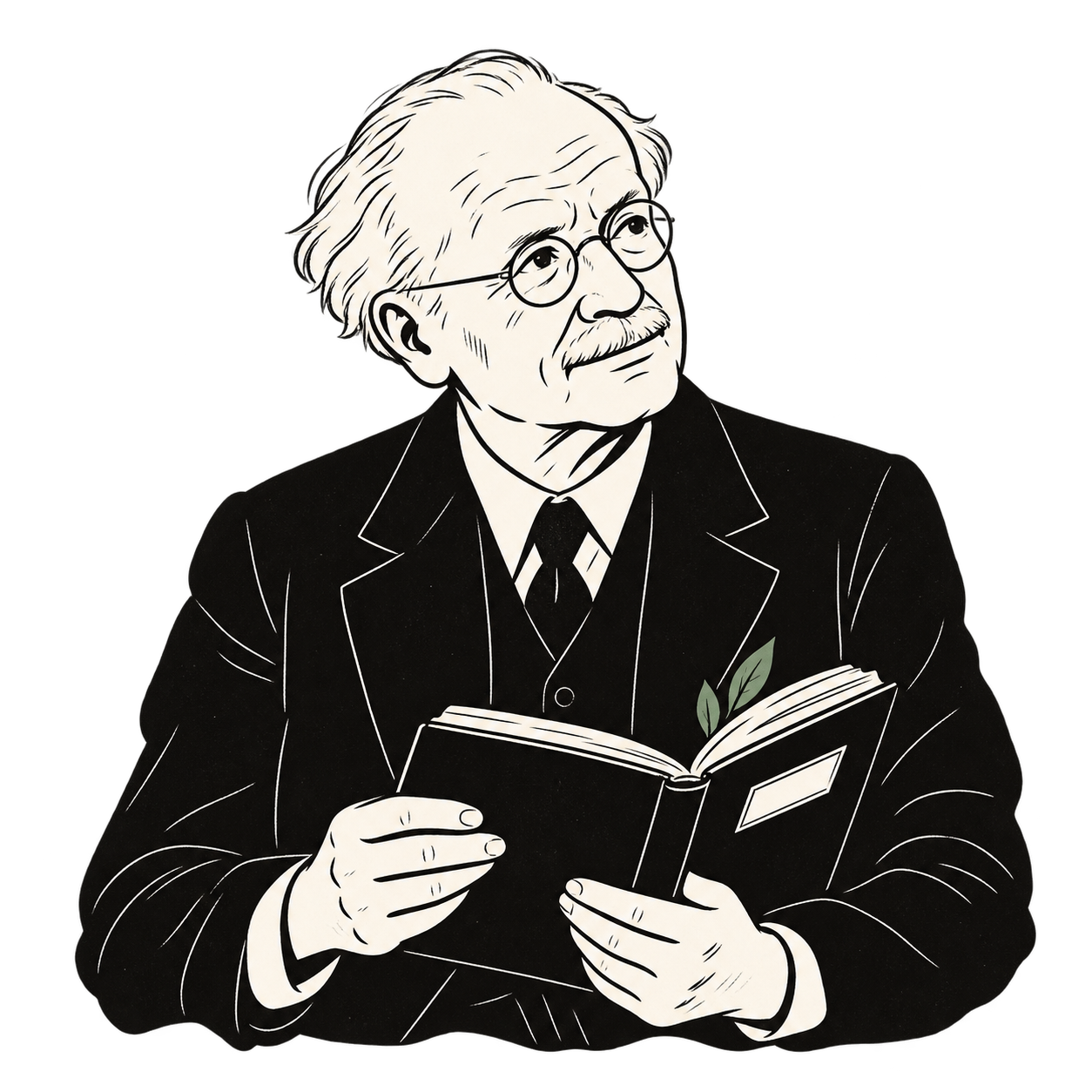
A deeper approach to knowing yourself
A journal can preserve a life while leaving its author largely unexplored. We can record our achievements, disappointments, and arguments for years without asking why certain events affect us so deeply, why the same conflicts keep returning, or why our private feelings differ from the person we present to the world.
Carl Jung’s psychology offers a demanding way to approach those questions. Applied to writing, it invites us to examine the perspective from which we tell our story—and to make room for experiences that disturb that perspective.
Jung’s framework is best understood here as analytical psychology, rather than a single ideology. The central ideas relevant to writing concern psychological development, unconscious life, symbols, and the relationship between the individual and society. They provide an interpretive approach to self-understanding. They should be distinguished from the experimental evidence on expressive writing.
The connection between Jung and writing is substantial, but it requires care. He did not leave behind a standardized journaling program. His own notebooks, theoretical essays, and autobiographical reflections illuminate different kinds of engagement with inner experience. The writing practices proposed below are contemporary applications of those ideas, not instructions quoted from a Jungian workbook.
The Black Books and inner experience
Jung’s personal example begins with an unusual kind of notebook. From 1913 onward, he recorded the imaginative experiences associated with what he called his confrontation with the unconscious. These records became The Black Books, and material from them contributed to The Red Book, or Liber Novus. As the Philemon Foundation explains, the notebooks were not conventional diaries of daily events: they documented active imaginations, mental states, and reflections on them.
The distinction matters. Recording what happened today and exploring what an inner image means are different activities. Jung’s example suggests that writing can become a place where an experience is allowed to develop before we rush to explain it.
Imagine writing about an ordinary disappointment and unexpectedly describing yourself as standing outside a locked house. You could replace the image with the word “sad.” You could also pause and ask what the house evokes: belonging, safety, family, an opportunity, a former life. This is an illustrative application of Jung’s approach. Its purpose is to open inquiry, while leaving interpretation provisional.
Individuation and the persona
The broad developmental aim of Jung’s psychology was individuation. In Two Essays on Analytical Psychology, he describes it as becoming a distinct psychological individual and distinguishes it from self-centered individualism. In paragraph 266, he offers the phrase:
“coming to selfhood”
A related obstacle is the persona, the socially adapted face through which we meet other people. In paragraph 305, Jung describes it as:
“a kind of mask”
The problem arises when a person identifies so completely with a role that other aspects of life lose recognition. Individuation involves a fuller relationship with oneself, alongside participation in shared human life.
Applied to writing, these ideas raise an uncomfortable question: “Who am I trying to appear to be on this page?”
Someone who prides themselves on independence might describe every disappointment as evidence that other people are unreliable. The journal may contain little acknowledgment of loneliness or a wish for care. Someone invested in being agreeable might record exhaustion repeatedly while avoiding the sentence “I am angry that I keep saying yes.”
Even private writing can become a performance. There may be no external audience, yet an imagined judge remains: the person we believe we ought to be.
A useful experiment is to write an account of an event, then add a second paragraph beginning, “What this account leaves out is…” Perhaps it leaves out envy, relief, dependence, affection, or uncertainty. The aim is to produce a more complete account, without treating the first version as worthless.
The shadow and moral responsibility
That movement toward greater honesty brings us to Jung’s shadow. In Aion, he writes:
“The shadow is a moral problem that challenges the whole ego-personality”
The passage continues by emphasizing the effort required to recognize disowned aspects of the personality as real. Jung also discusses how projections make such recognition difficult: an emotionally charged quality seems to belong entirely to someone else. His account allows that positive qualities, too, can remain unrecognized.
For reflective writing, the implication is ethical as well as psychological. An admission becomes useful when it changes our understanding of responsibility.
Suppose you write, “My colleague is unbearable because they always want recognition.” A further inquiry might ask whether you also want recognition, whether you feel ashamed of wanting it, and whether their behavior exposes an unmet need of your own.
That inquiry does not establish that the colleague has done nothing wrong. It asks whether your response contains information about you as well as them. External wrongdoing and personal sensitivity can coexist.
Likewise, writing “I was cruel because I felt excluded” may explain part of an action. It does not repair its consequences. A more complete entry would ask what an apology, boundary, or changed behavior now requires. Self-understanding becomes more substantial when it reaches beyond the page.
Giving emotions a recognizable form
Jung’s autobiographical reflections help explain why he valued giving inner experience a recognizable form. In the chapter “Confrontation with the Unconscious” in Memories, Dreams, Reflections, he recalls finding images within intense emotions. He describes the result with the words:
“I was inwardly calmed and reassured.”
The book was recorded and edited by Aniela Jaffé, and the passage is a retrospective account of Jung’s experience. It is not experimental proof that expressing emotions through images will produce the same effect for everyone.
The practical possibility is nevertheless interesting. “I feel anxious” names a state. “I feel like someone waiting for a verdict” gives it a scene. The scene suggests further questions: Who is judging? What accusation is feared? What would acquittal mean?
Such images can help articulate experience. They also require skepticism. A compelling metaphor may reveal one aspect of a situation while concealing another. The writer should remain free to revise it.
Symbols, dreams, and patient interpretation
This is especially relevant to Jung’s understanding of symbols. In his contribution to Man and His Symbols, “Approaching the Unconscious,” he distinguishes a symbol from a conventional sign. A symbol points beyond its immediately familiar meaning toward something not fully known. He writes:
“It implies something vague, unknown, or hidden from us.”
The book contains contributions by several authors, so its entire contents should not be attributed to Jung.
Applied to a dream journal, this encourages patience with interpretation. A river might evoke danger for one person, home for another, and an important childhood journey for a third. An image’s personal associations deserve attention before it is assigned a ready-made explanation.
A practical entry could preserve the dream first, then record what its people, objects, and places bring to mind. Interpretation can follow as a question: “Could this relate to the transition I am avoiding?” That phrasing leaves room for correction. It also keeps separate what was dreamed, what was associated with it, and what was inferred.
Archetypes and the stories we inhabit
Jung’s theory extends beyond personal associations through the collective unconscious and archetypes. In “The Concept of the Collective Unconscious,” he proposes a layer of psychic life that does not originate solely in individual experience. Its archetypes are underlying forms that find expression in recurring images and patterns. This is a theoretical claim in Jung’s psychology, rather than a conclusion established by journaling research.
For a writer, archetypal thinking can suggest comparisons with stories of departure, sacrifice, transformation, or return. Those comparisons should enrich attention to the particular life being described. Calling oneself a hero explains little unless one also examines the specific choices, relationships, and costs involved.
A myth can offer a question. It can also become a flattering costume.
Active imagination and the transcendent function
The most direct connection between Jung’s theory and a writing method appears in active imagination and his essay “The Transcendent Function.” There, Jung describes giving expression to unconscious material and then bringing conscious judgment into a relationship with it. He explicitly discusses recording inner words and answering them in writing. The transcendent function concerns a development emerging through the encounter between conscious and unconscious positions.
A contemporary written dialogue inspired by that approach might explore a conflict about work:
The part that wants achievement: “If I slow down, I will become irrelevant.”
The exhausted part: “If you continue like this, there will be nothing left to enjoy.”
The reflective response: “What commitment would let me take my work seriously while protecting the life that makes it worthwhile?”
This example illustrates a possibility, rather than reproducing Jung’s own dialogue. The writer gives competing concerns enough space to become intelligible, then exercises judgment about their implications.
The crucial question is whether the dialogue produces a more responsible decision. An inner statement can be meaningful without being factually correct or deserving obedience. An imagined accusation, for example, is not evidence that another person has actually accused you.
The individual, society, and ideology
Jung’s concern with self-knowledge also had a social dimension. In The Undiscovered Self, he examines the vulnerability of individuals within mass society and ideological movements. His argument connects resistance to collective pressure with a more developed understanding of one’s own psychological life.
Writing offers one possible setting for that inquiry. A person might ask which convictions they have examined, which they repeat to retain belonging, and which become difficult to question because their identity depends on them. This is an application of Jung’s argument to contemporary reflective practice.
The same scrutiny belongs in our reading of Jung. His concepts should remain open to criticism. A journal that merely supplies Jungian labels for every experience can become another way of avoiding uncertainty.
Taking self-knowledge beyond the page
Taken seriously, this approach to writing asks for three kinds of attention: attention to the experience itself, attention to the interpretation we place upon it, and attention to what follows in ordinary life. A dream can be recorded without being declared prophetic. Anger can be acknowledged without being justified. A role can be questioned while its responsibilities are still honored.
The deepest contribution Jung offers to reflective writing is a willingness to let self-knowledge disturb a comfortable story. The page becomes useful when it can hold the sentence we expected to write alongside the sentence we were reluctant to admit.
What matters afterward is whether we can live with greater honesty toward ourselves and greater responsibility toward other people.